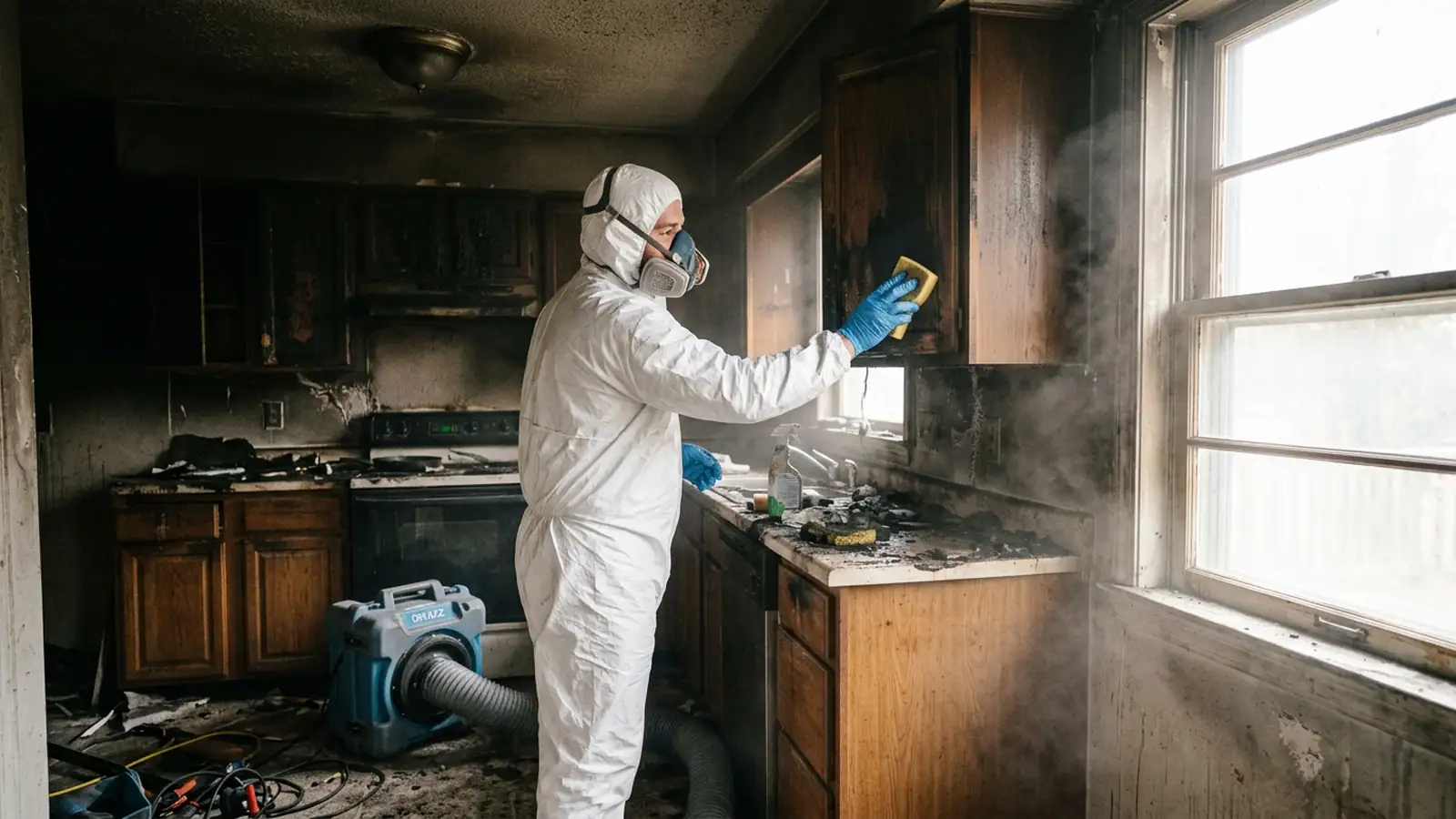
A fire does not have to burn your home to damage it. A pan fire extinguished in seconds, a furnace puff-back, a candle, a neighboring unit fire or weeks of wildfire smoke can coat every surface in a house with soot and leave an odor that no amount of airing out removes. Smoke and soot cleanup is a specialized cleaning discipline: different residues require different chemistry, and odor removal only works when the source particles are removed or sealed.
Water Restoration connects you with smoke damage cleanup crews in your area. Call (888) 755-3821 to describe the situation and arrange an assessment.
How smoke spreads through a building
Hot smoke rises and moves toward cooler areas, which is why soot collects on upper walls, ceilings, inside closets and in rooms far from the fire. It is drawn into HVAC returns and distributed through the ductwork. Smoke particles are small enough to pass through drywall into wall cavities and attic insulation, and they are attracted to synthetic materials, plastics and the cooler surfaces of windows and exterior walls. Even a small kitchen fire can leave residue in every room of the house.
Types of soot and how each is cleaned
- Dry soot (fast-burning wood and paper fires) is removed with dry chemical sponges and HEPA vacuuming before any wet cleaning, which would smear it.
- Wet soot (smoldering plastics and synthetics) is sticky and requires degreasing agents, often followed by repainting with a stain-blocking primer.
- Protein residue (kitchen fires) is a nearly invisible film that yellows paint and varnish and carries a rancid odor; it needs enzyme and alkaline cleaners on every surface.
- Fuel oil soot (furnace puff-backs) is oily, webs into corners and spreads through ducts; cleaning includes the entire HVAC system.
- Wildfire smoke leaves fine particulate and odor in insulation, soft goods and ducts, usually without heavy visible soot.
Our smoke and soot cleanup process
- Assessment. Technicians identify the type of residue, test-clean surfaces to choose the right method, and determine which materials can be restored.
- Air filtration. HEPA air scrubbers begin removing airborne particulate immediately.
- Dry cleaning phase. Ceilings, walls, trim, cabinets and contents are dry-sponged and HEPA vacuumed from top to bottom.
- Wet cleaning phase. Surfaces are cleaned with the appropriate agents, rinsed and dried; ductwork is cleaned and the HVAC system sealed or filtered.
- Contents processing. Soft goods go to specialty laundering or ozone chambers; hard contents are cleaned ultrasonically or by hand; electronics are evaluated.
- Deodorization. Thermal fogging, hydroxyl generators or ozone treatment neutralize odor; porous structural surfaces are sealed with an odor-blocking primer.
- Final cleaning and repaint. Walls and ceilings are primed and painted, and the space is wiped down a final time.
Why odor comes back and how professionals prevent it
Smoke odor returns on humid days and when the heat comes on because odor molecules trapped in porous materials are released as they warm. Air fresheners and household ozone units mask the smell temporarily. Permanent removal requires removing the most heavily contaminated materials (often attic insulation and heavily sooted drywall), cleaning everything else, sealing structural surfaces, and treating the air and cavities with fogging or hydroxyl. When each step is done, the smell is gone for good.
Puff-backs and wildfire smoke
An oil furnace puff-back is a small explosion of unburned fuel in the combustion chamber that sends oily soot through the ductwork into every room. It happens most often at the start of heating season. Cleanup includes the furnace repair, full duct cleaning, and cleaning of every surface in the home.
Wildfire smoke is increasingly common across the West and beyond. Homes near a fire perimeter can accumulate ash and particulate inside walls, attics and soft goods. Insurance policies generally cover smoke damage from a wildfire, and professional cleaning of ducts, insulation and contents is often needed even when the structure itself never burned.
Insurance for smoke damage
Smoke is a covered peril in standard property policies, including smoke from a fire on a neighboring property and from wildfires. Puff-backs are typically covered as sudden and accidental events. The claim usually involves a structural cleaning estimate, a contents inventory and, when needed, additional living expenses while the home is cleaned. Restoration companies prepare this documentation and can meet the adjuster on site.
Call (888) 755-3821
Smoke & Soot Cleanup FAQs
Can I paint over smoke-damaged walls?
Only after the walls have been cleaned and sealed with a stain- and odor-blocking primer. Painting directly over soot leaves the odor and often causes the paint to fail.
How do you get smoke smell out of clothes and furniture?
Clothing and fabrics are treated with specialty detergents and ozone or hydroxyl treatment. Upholstered furniture is cleaned and deodorized or, if heavily saturated, replaced. Solid wood and hard goods are cleaned by hand or ultrasonically.
Does the HVAC system need to be cleaned after a fire?
Almost always. Ducts, the air handler and the filter collect soot and redistribute it every time the system runs. Cleaning the system and replacing filters is a standard part of smoke restoration.
Is soot dangerous to breathe?
Soot is a fine particulate that can irritate the lungs and may carry toxic combustion byproducts. Avoid dry-sweeping it, wear an N95 or better respirator if you must be in the space, and keep children and people with respiratory conditions away until cleanup is complete.
How long does smoke cleanup take?
A light smoke event in a few rooms may take a few days. A whole-house protein fire or puff-back cleanup typically takes one to three weeks including contents processing and repainting.