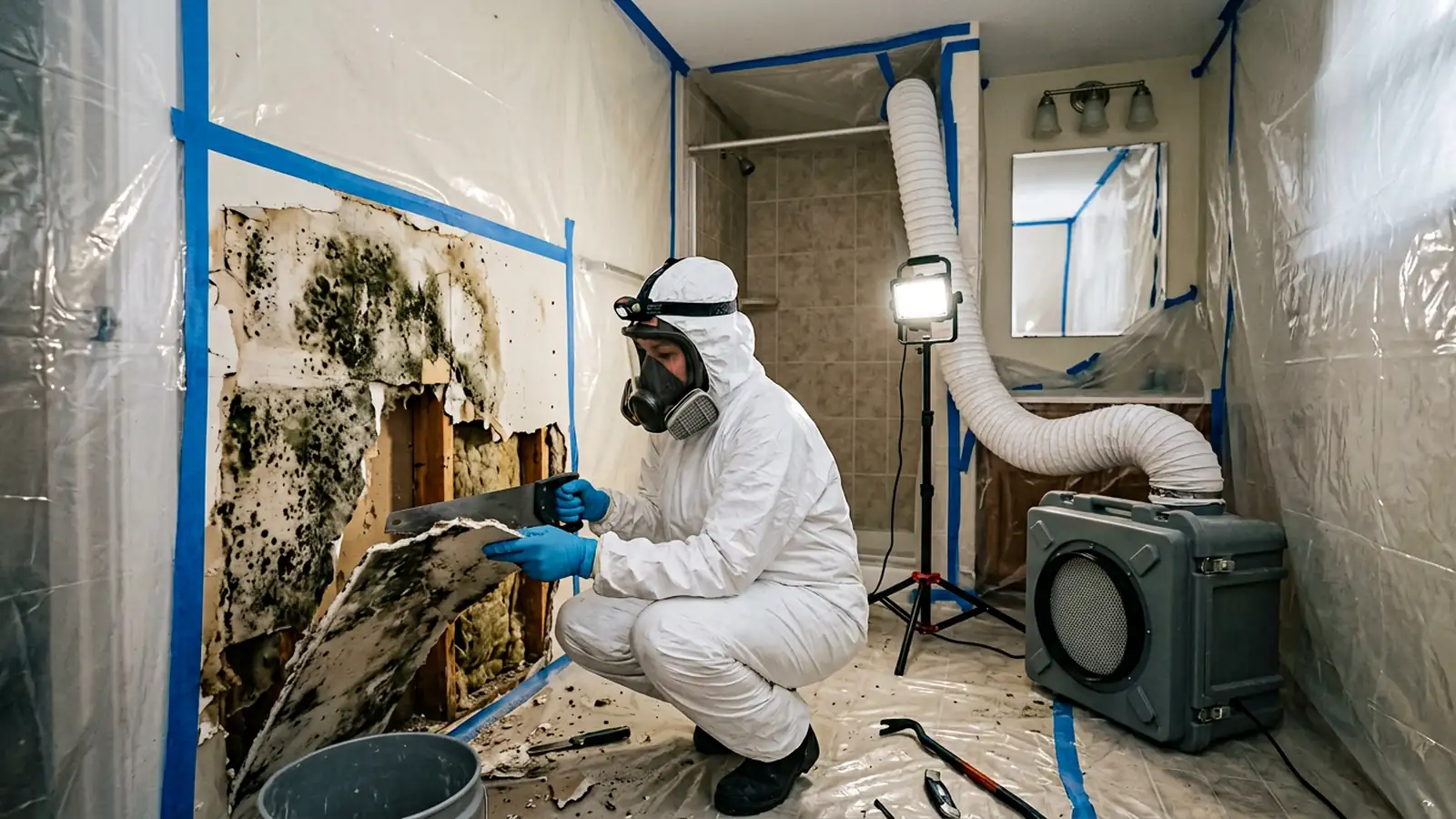
Mold is a moisture problem first and a cleaning problem second. Spores are everywhere; they only become a colony on your drywall, framing or subfloor when water is present for more than a day or two. Professional mold remediation finds and corrects the moisture source, safely removes contaminated materials under containment so spores do not spread through the building, cleans and treats the remaining structure, and verifies that the area is back to normal conditions.
Whether you have found black spots behind a baseboard, a musty smell in a crawlspace or a full wall of growth after a leak, Water Restoration can connect you with a local mold remediation contractor. Call (888) 755-3821 to describe what you are seeing and arrange an inspection.
Where mold comes from and why it keeps returning
Mold needs three things: spores (always present), an organic food source (paper-faced drywall, wood, dust, fabric) and moisture. Remove the moisture and growth stops. That is why remediation that only wipes or sprays visible growth fails: the slow roof leak, the sweating cold-water line, the wet crawlspace or the undersized bathroom fan is still feeding the colony.
Common moisture sources behind mold problems include plumbing leaks inside walls, past water damage that was never fully dried, condensation on cold surfaces, high indoor humidity, roof and window flashing leaks, wet crawlspaces and basements, and HVAC condensate leaks.
Health and property concerns
The U.S. Environmental Protection Agency and public health agencies note that exposure to indoor mold can cause nasal stuffiness, throat irritation, coughing, eye irritation and skin irritation, with more serious reactions possible in people with allergies, asthma or weakened immune systems. Beyond health, mold feeds on building materials: it stains and weakens drywall, delaminates wood products and, left long enough, contributes to rot in framing and subfloor.
Mold also affects property transactions. Visible growth or a documented history of unaddressed mold routinely shows up in home inspections and can derail a sale or lease.
When to call a professional instead of cleaning it yourself
EPA guidance suggests that a homeowner can often clean a small area of mold (roughly less than 10 square feet) on a hard surface with detergent and water and proper protection. Professional remediation is recommended when:
- Growth covers more than about 10 square feet or appears in multiple rooms
- Mold is inside walls, under flooring, in the attic or in HVAC ductwork
- The source was sewage or contaminated flood water
- Occupants have asthma, allergies, compromised immunity or unexplained respiratory symptoms
- You can smell mold but cannot find it
- A home inspection, landlord dispute or insurance claim requires documented remediation and clearance
Our mold remediation process
- Assessment and moisture investigation. The contractor inspects visible growth, uses moisture meters and infrared imaging to find the water source, and determines the extent of the affected area. Independent testing can be arranged if documentation is needed.
- Containment. The work area is isolated with plastic sheeting and negative air pressure so spores disturbed during removal do not spread to clean parts of the building.
- Air filtration. HEPA air scrubbers run continuously during and after the work to capture airborne spores and particles.
- Removal of contaminated materials. Porous materials with growth, such as drywall, insulation, carpet and ceiling tile, are bagged inside containment and removed. Structural wood is cleaned by HEPA vacuuming, damp wiping, sanding or media blasting as needed.
- Cleaning and treatment. Remaining surfaces are HEPA vacuumed and cleaned; an EPA-registered antimicrobial is applied where appropriate, and an encapsulant may be used on cleaned framing.
- Drying and moisture correction. The underlying leak, humidity or drainage problem is corrected and the structure dried to normal moisture content so the mold cannot return.
- Verification. A visual inspection and, when required, independent post-remediation testing confirm the area is clean before containment comes down and rebuild begins.
What professional mold remediation includes
A proper remediation scope follows the IICRC S520 standard and includes the containment setup, negative air and HEPA filtration, personal protective equipment, removal and disposal of contaminated materials, detailed cleaning, antimicrobial application, drying, and a written report with photos. It should also identify the moisture source and either fix it or specify the repair that another trade must perform.
Be cautious of any company that offers to "spray" or "fog" mold away without removing contaminated materials or fixing the moisture source, or that quotes a price without inspecting the property. Several states, including Texas, Florida, Louisiana and New York, license mold assessors and remediators and prohibit the same company from both testing and remediating the same job without disclosure.
Cost factors and insurance
Mold remediation cost depends on the size of the affected area, how accessible it is (a crawlspace or attic costs more than an open wall), the materials involved, whether contents are affected, and how much reconstruction is needed after removal. A small bathroom wall is far less involved than a whole-house attic remediation.
Homeowners insurance treats mold differently from other water damage. Many policies cover mold only when it results from a covered sudden loss, such as a burst pipe, and often cap mold coverage at a fixed dollar limit. Mold from long-term leaks, humidity or deferred maintenance is usually excluded. A remediation company experienced with claims can document the cause of the growth in a way that supports coverage when it applies.
Preventing mold after remediation
- Keep indoor relative humidity below 60 percent, ideally 30–50 percent
- Run exhaust fans in bathrooms and kitchens and vent dryers outdoors
- Fix plumbing and roof leaks right away and dry any wet area within 24–48 hours
- Make sure gutters, downspouts and grading move water away from the foundation
- Insulate cold-water lines and ducts that sweat in humid weather
- Consider a dehumidifier or vapor barrier in damp basements and crawlspaces
Call (888) 755-3821
Mold Remediation FAQs
Is black mold more dangerous than other mold?
Color does not reliably indicate toxicity. Stachybotrys chartarum, often called black mold, can produce mycotoxins, but many harmless molds are also dark, and some light-colored molds are allergenic. Any significant indoor growth should be removed and its moisture source fixed regardless of color.
Do I need mold testing before remediation?
Not always. If you can see growth, the EPA notes that sampling is usually unnecessary because the mold needs to be removed either way. Testing is useful when you smell mold but cannot find it, when occupants have health concerns, when a landlord, buyer or insurer needs documentation, or for post-remediation clearance.
Can I just use bleach on mold?
Bleach can remove surface staining on non-porous materials, but it does not penetrate porous materials like drywall or wood, where the mold roots are, and the water in bleach can actually feed regrowth. It also does nothing about the moisture source.
How long does mold remediation take?
A single room or small crawlspace job often takes one to three days. Larger projects involving multiple rooms, attics or whole crawlspaces can take a week or more, plus reconstruction time afterward.
Will mold come back after remediation?
Not if the moisture problem is corrected. Mold returns only when materials get wet again. A reputable contractor will identify the source, verify dryness and provide guidance on humidity control before closing out the job.
Should I leave the house during mold remediation?
For small, well-contained jobs most families stay home and simply avoid the work area. For large remediations, or when someone in the household is sensitive, immunocompromised or has asthma, staying elsewhere during the removal phase is often recommended.