Mold is a moisture problem first and a cleaning problem second. Whether you have found black spots behind a baseboard in your Lynden home, smell something musty in the crawlspace or had growth flagged during a home inspection, Water Restoration can connect you with a local mold remediation company that finds the source, removes the growth safely under containment and verifies the result.
Lynden is a smaller community in Washington, home to roughly 16,800 residents, with a mix of historic homes, post-war neighborhoods and newer construction, with farms and acreage properties nearby. Every property type in Lynden has its own failure points, which is why crews map moisture with meters and infrared cameras before deciding what to remove.
Where mold comes from in Lynden homes
Local conditions in Lynden follow the broader pattern across Washington. Western Washington's long wet season saturates crawlspaces and overwhelms gutters and drainage, with atmospheric rivers producing river flooding, while eastern Washington contends with hard freezes and wildfire. Smoke damage from regional fires is now a recurring summer issue. Problems tend to peak during the november-to-march rainy season, but plumbing failures and appliance leaks happen in every month of the year.
- Damp crawlspaces with mold on floor joists and subfloor
- Salt air and coastal humidity that keep building materials damp
- Moisture left behind after fire-suppression water
- Window, door and siding leaks after heavy rain
- Refrigerator, dishwasher and washing machine leaks behind appliances
- Flood water that was never fully dried out of walls and floors
- HVAC systems and ductwork with mold on coils and insulation
- Water heater and plumbing leaks in utility closets
Do you need professional mold remediation in Lynden?
The EPA suggests that a homeowner can often clean a small area of mold, roughly under 10 square feet on a hard surface, with detergent, water and protective gear. Professional remediation is recommended when growth covers a larger area or multiple rooms, when it is inside walls, under flooring, in the attic or in ductwork, when the source was sewage or flood water, when occupants have asthma, allergies or compromised immunity, when you can smell mold but cannot find it, or when a home sale, lease dispute or insurance claim requires documented work.
Health agencies note that mold exposure can cause nasal congestion, throat and eye irritation, coughing and skin irritation, with more serious reactions in people with allergies, asthma or weakened immune systems. In Lynden, where moisture problems often go unnoticed until growth is visible, symptoms that improve when you leave the house are a classic sign.
Containment, removal, verification
- Assessment and moisture investigation with meters and infrared imaging to find the source and the full extent of growth. Independent testing can be arranged when documentation is needed.
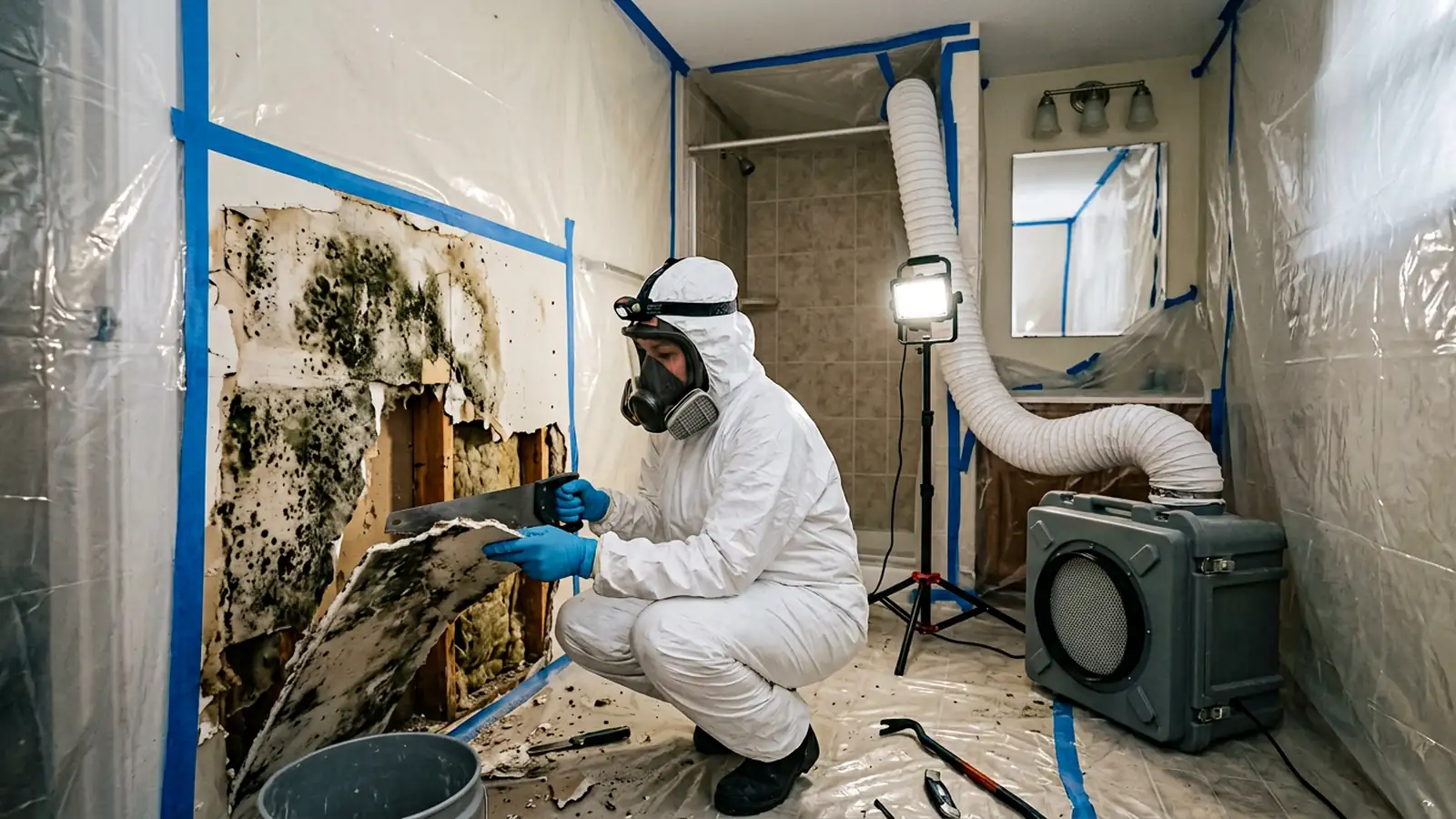
- Containment. The work area is sealed with plastic sheeting and placed under negative air pressure so spores disturbed during removal do not spread.
- HEPA air filtration runs continuously during and after the work to capture airborne spores and dust.
- Removal of contaminated porous materials such as drywall, insulation, carpet and ceiling tile, bagged inside containment. Structural wood is HEPA vacuumed, damp wiped, sanded or media blasted as needed.
- Antimicrobial application and, where appropriate, encapsulation of cleaned surfaces.
- Correction of the moisture source, drying to normal levels and verification, by inspection or independent clearance testing, before containment comes down and reconstruction begins.
Inspection, sampling and clearance
If you can see growth, the EPA notes that sampling is usually unnecessary because it must be removed either way. Testing is valuable when you smell mold but cannot find it, when occupants have health concerns, when a landlord, buyer or insurer needs documentation, or for post-remediation clearance. Ask whether the company performs its own testing or uses an independent inspector; for disputes and real estate transactions, independent testing carries more weight.
Pricing, estimates and insurance claims
Mold remediation cost in Lynden depends on the size of the affected area, how accessible it is, what materials are involved and whether the moisture source has already been fixed.
Insurance treats mold cautiously: it is often covered only when it results from a covered sudden loss, such as a burst pipe, and many policies cap mold coverage at a set dollar amount. Mold from humidity or long-term leaks is usually excluded.
The restoration companies we connect you with in Lynden handle claims every day and can explain what is likely to be covered before work begins.
Areas we serve in and around Lynden
We route calls from ZIP code 98264 to restoration companies that work Lynden and Whatcom County every week.
The same crews also serve nearby communities including Everson (6 mi), Nooksack (6 mi), Custer (7 mi), Ferndale (8 mi), Sumas (12 mi), Bellingham (13 mi), Blaine (13 mi), Maple Falls (15 mi), Lummi Island (19 mi) and Deming (19 mi). If you are just outside Lynden, call anyway; coverage areas overlap.
Why call Water Restoration
- There is no cost or obligation to call and talk through what you are seeing
- One number covers water, fire, smoke, mold, sewage and biohazard emergencies
- You are connected with a restoration company that actually serves Lynden, not a national call center that will call you back tomorrow
- A live person answers around the clock, because water and fire do not keep business hours
- Restoration companies in the network are independent local businesses; confirm their licensing and insurance and get the scope in writing
Mold Remediation in Lynden: FAQs
Is mold common in Lynden?
Yes. Wherever water damage was not fully dried, or where humidity, condensation or leaks persist, mold follows. Local crews see it year-round.
Is black mold in my Lynden home dangerous?
Color does not reliably indicate toxicity. Stachybotrys can produce mycotoxins, but many harmless molds are dark and some light-colored molds are strongly allergenic. Any significant indoor growth should be removed and its moisture source fixed, regardless of color.
What does mold smell like, and what if I smell it but cannot see it?
A musty, earthy odor, often strongest in crawlspaces and after rain. Odor without visible growth usually means mold inside a wall, under flooring or in the HVAC system; a moisture inspection with infrared imaging can locate it.
Should we leave the house during remediation?
For small, well-contained jobs most families stay and simply avoid the work area. For large projects, or when someone is sensitive, immunocompromised or asthmatic, staying elsewhere during removal is often recommended.
Do you remediate mold in commercial buildings in Lynden?
Yes. Offices, retail spaces, multifamily buildings and other commercial properties are remediated under containment so the rest of the building can keep operating, with documentation for tenants, lenders and insurers.