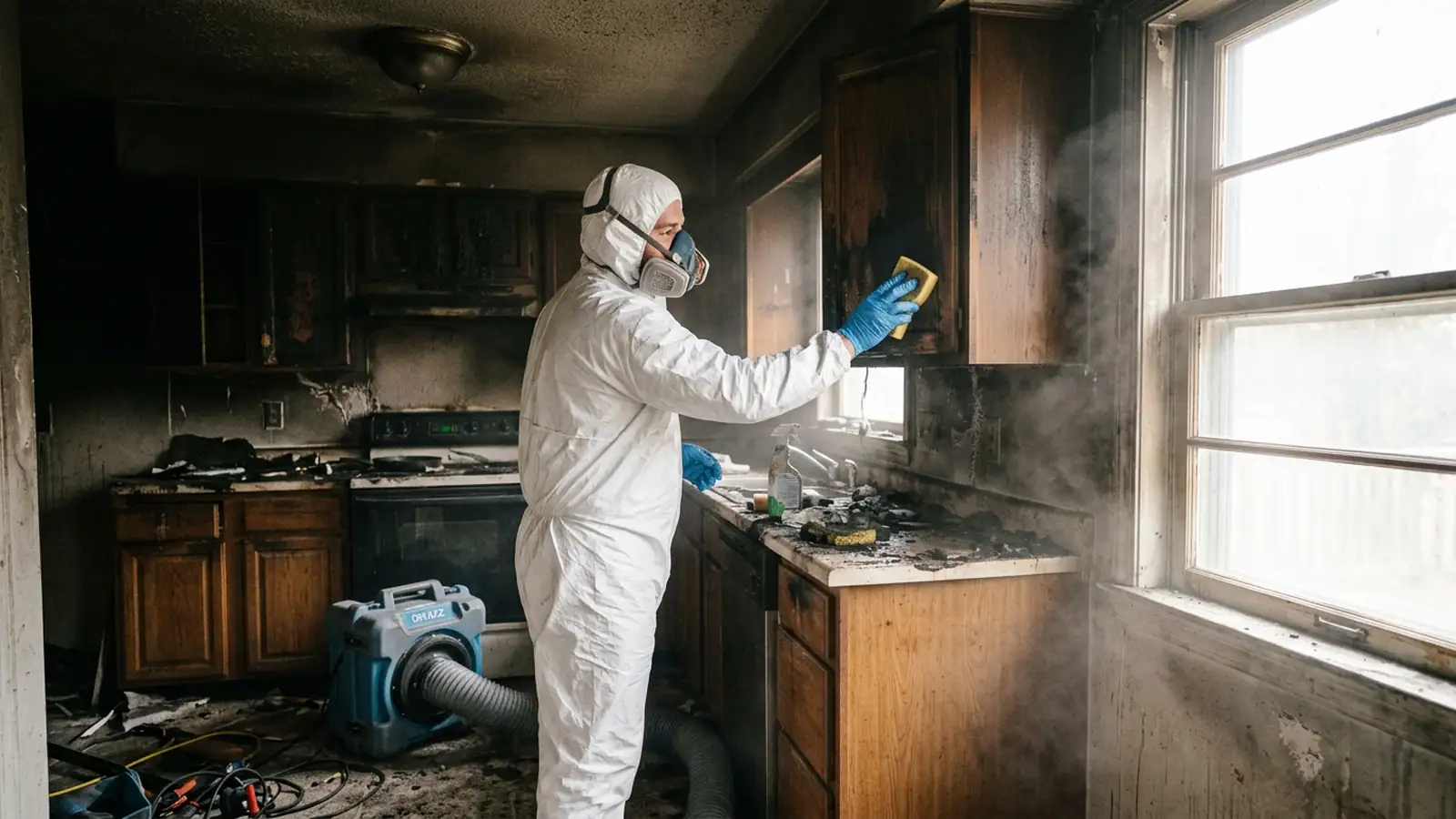
After the fire trucks leave a Garland home, what remains is a structure that is wet from suppression water, coated in acidic soot and saturated with smoke odor, often with openings to the weather. Water Restoration connects you with local fire damage restoration crews that secure the property, remove the water, clean the soot, eliminate the odor and rebuild.
Garland is one of the largest cities in Texas, home to roughly 250,400 residents, with high-rise condominiums, older apartment buildings, dense single-family neighborhoods and large commercial and industrial properties. Home fires peak in winter, when space heaters, fireplaces and furnaces are running and holiday cooking and decorating add risk.
Fire and smoke damage we handle in Garland
Every property type in Garland has its own failure points, which is why crews map moisture with meters and infrared cameras before deciding what to remove. Cooking remains the leading cause of home fires here, as it is nationwide.
- Grass and brush fires that spread to fences, outbuildings and homes
- Furnace malfunctions at the start of heating season
- Electrical shorts in humid attics and crawlspaces
- Space heater, fireplace and chimney fires during cold weather
- Kitchen and cooking fires, the leading cause of home fires
- Small fires that were extinguished quickly but filled the house with smoke
- Candle and holiday decoration fires
- Electrical fires when power is restored to water-damaged wiring after a storm
Why fire damage gets worse by the day
Soot is acidic. Within hours it discolors plastics and countertops; within days it etches glass, pits metal and permanently stains grout. Smoke odor penetrates drywall, insulation and upholstered contents and becomes harder to remove each day. Meanwhile the water used to put out the fire is soaking into the same materials, starting the mold clock that every water loss faces.
That is why restoration companies in Garland aim to be on site within a day or two of the fire even when reconstruction will take months. Board-up protects the property; extraction and drying stop the water damage; and the first cleaning pass removes the most corrosive residue.
From board-up to rebuild
- Dispatch and assessment. A local crew confirms the property is safe to enter and plans the stabilization.
- Securing the structure. Broken openings are boarded, damaged roofing tarped and the site secured.
- Water removal and drying. Suppression water is extracted and the structure dried to prevent secondary damage and mold.
- Structural cleaning. Walls, ceilings, cabinets, fixtures and the HVAC system are cleaned using methods chosen for wet, dry or protein smoke.
- Contents inventory, pack-out and cleaning. Salvageable belongings are documented, cleaned on or off site and stored; non-salvageable items are listed for the claim.
- Odor removal with thermal fogging, hydroxyl or ozone and sealing of structural surfaces, followed by full reconstruction.
Salvage versus replace
Hard, non-porous items clean up well; porous items that absorbed heavy smoke usually do not. A reputable crew will test-clean before committing to a method, document non-salvageable items for your claim rather than charging to clean them, and tell you honestly when replacement is the better path.
What fire damage restoration costs in Garland and what insurance covers
Fire restoration costs in Garland vary enormously, from a few days of cleaning after a contained kitchen fire to months of reconstruction after a structural fire.
Fire is a named peril on standard policies. Expect the claim to involve a structural estimate, a contents inventory and, if you cannot stay in the home, additional living expense coverage.
Ask the crew to walk you through the estimate and the claim process; good documentation from day one is the best way to get a claim paid.
Service area: Garland and Dallas County
We route calls from all 9 Garland ZIP codes, including 75040, 75041, 75042 to restoration companies that work Garland and Dallas County every week.
ZIP codes served in Garland: 75040, 75041, 75042, 75043, 75044, 75045, 75046, 75047, 75049.
The same crews also serve nearby communities including Sachse (4 mi), Rowlett (5 mi), Richardson (6 mi), Wylie (9 mi), Sunnyvale (9 mi), Mesquite (10 mi), Plano (10 mi), Dallas (12 mi), Addison (12 mi) and Rockwall (12 mi). If you are just outside Garland, call anyway; coverage areas overlap.
Why call Water Restoration
- You are connected with a restoration company that actually serves Garland, not a national call center that will call you back tomorrow
- Restoration companies in the network are independent local businesses; confirm their licensing and insurance and get the scope in writing
- One number covers water, fire, smoke, mold, sewage and biohazard emergencies
- There is no cost or obligation to call and talk through what you are seeing
- The companies we work with deal with insurance adjusters daily and can bill covered mitigation directly to your carrier
Fire Damage in Garland: FAQs
How long does fire restoration take in Garland?
Emergency stabilization happens within a day or two. Cleaning and deodorizing a smoke-damaged home typically takes one to several weeks. Full reconstruction after a significant fire can take months, depending on the damage and Garland permitting timelines.
Can I choose my own restoration contractor?
In nearly all cases, yes. Be cautious of anyone who shows up uninvited at a fire scene. Take the time to call a company you have vetted and get the scope in writing.
Do you provide emergency board-up in Garland?
Yes. Board-up, tarping and site security are dispatched around the clock so the property is protected from weather and intruders while the claim and cleanup get underway.
What should I do first after a fire at my Garland home?
Make sure everyone is safe and do not re-enter until the fire department clears the structure. Call your insurance company to open a claim, then call (888) 755-3821 for emergency board-up and mitigation. Photograph the damage before anything is moved, if it is safe to do so.
Can smoke smell be removed completely?
Yes, when the sources are addressed: removing heavily contaminated materials, cleaning everything else including ducts, sealing structural surfaces and treating air and cavities with thermal fogging or hydroxyl. Painting over smoke without cleaning and sealing rarely works.