Winter condensation on windows and in attics, followed by spring moisture in basements and crawlspaces, gives mold two seasons to get started. In Bay City, that makes it common for mold to show up weeks after a leak that seemed minor at the time. Call (888) 755-3821 and we will connect you with a remediation company that serves ZIP codes 48706, 48707 and 48708 for an inspection and a written scope.
Properties in Bay City (Bay County) include single-family homes of varying ages, a few apartment and townhome communities, and locally owned businesses, and each has typical places where moisture hides. Many homes date back decades, with galvanized pipes, cast iron sewer lines and electrical systems that were never designed for modern loads.
Where mold comes from in Bay City homes
Property owners in Bay City deal with the same regional risks found throughout Michigan. Michigan homes almost always have basements, and sewer backups and sump failures during intense summer rain, plus burst pipes and ice dams in winter, make up most of the state's water damage. Lake-effect snow and heavy roof loads add to the risk on the west side of the state. Problems tend to peak during winter and the spring thaw, but plumbing failures and appliance leaks happen in every month of the year.
- Basement walls and floors that stay damp after rain and snowmelt
- Bathrooms with poor ventilation and recurring ceiling or grout mold
- Window, door and siding leaks after heavy rain
- Leaks under kitchen and bathroom sinks
- Bathroom fans venting into cold attics
- Water heater and plumbing leaks in utility closets
- Attic and ceiling moisture from ice dams and roof condensation
- Meltwater seepage into foundations each spring
Do you need professional mold remediation in Bay City?
The EPA suggests that a homeowner can often clean a small area of mold, roughly under 10 square feet on a hard surface, with detergent, water and protective gear. Professional remediation is recommended when growth covers a larger area or multiple rooms, when it is inside walls, under flooring, in the attic or in ductwork, when the source was sewage or flood water, when occupants have asthma, allergies or compromised immunity, when you can smell mold but cannot find it, or when a home sale, lease dispute or insurance claim requires documented work.
Bleach is not a solution: it removes surface staining on non-porous materials but does not penetrate drywall or wood where the growth is rooted, and the water in it can feed regrowth. Porous materials with growth are removed; structural wood is cleaned, treated and dried.
Containment, removal, verification
- Assessment and moisture investigation with meters and infrared imaging to find the source and the full extent of growth. Independent testing can be arranged when documentation is needed.
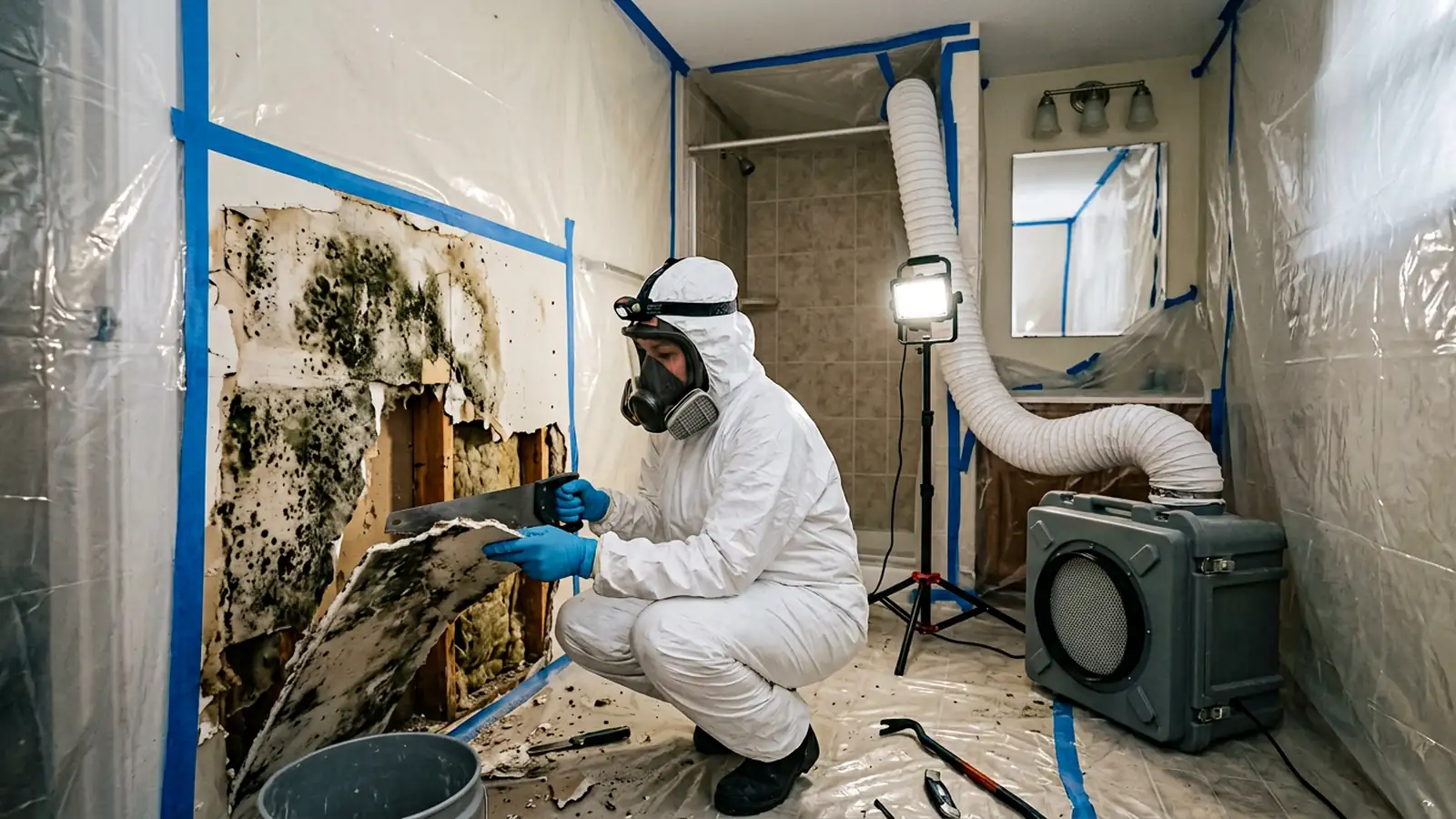
- Containment. The work area is sealed with plastic sheeting and placed under negative air pressure so spores disturbed during removal do not spread.
- Air scrubbing. HEPA air scrubbers clean the air throughout the project.
- Removal and cleaning. Porous materials with growth are removed; framing and sheathing are cleaned by HEPA vacuuming, wiping and abrasive methods where required.
- Antimicrobial application and, where appropriate, encapsulation of cleaned surfaces.
- Drying and moisture correction so the structure returns to normal moisture content, followed by visual and, when required, independent post-remediation verification before rebuild.
Do you need mold testing?
If you can see growth, the EPA notes that sampling is usually unnecessary because it must be removed either way. Testing is valuable when you smell mold but cannot find it, when occupants have health concerns, when a landlord, buyer or insurer needs documentation, or for post-remediation clearance. Ask whether the company performs its own testing or uses an independent inspector; for disputes and real estate transactions, independent testing carries more weight.
Pricing, estimates and insurance claims
A small bathroom wall and a whole crawlspace are very different remediation projects. Size, access, materials and the amount of reconstruction afterward drive the price.
Insurance treats mold cautiously: it is often covered only when it results from a covered sudden loss, such as a burst pipe, and many policies cap mold coverage at a set dollar amount. Mold from humidity or long-term leaks is usually excluded.
Get the scope and pricing in writing, ask what the carrier typically covers, and keep every receipt for emergency expenses.
Service area: Bay City and Bay County
Coverage in Bay City includes ZIP codes 48706, 48707 and 48708, along with the rest of Bay County.
The same crews also serve nearby communities including Kawkawlin (4 mi), Essexville (6 mi), University Center (7 mi), Auburn (9 mi), Linwood (11 mi), Munger (11 mi), Carrollton (13 mi), Pinconning (15 mi), Freeland (16 mi) and Saginaw (16 mi). If you are just outside Bay City, call anyway; coverage areas overlap.
Why Bay City property owners call Water Restoration
- You can ask about licensing, insurance and IICRC certification before any work begins, and you should
- One number covers water, fire, smoke, mold, sewage and biohazard emergencies
- Crews document the loss with photos, moisture readings and itemized estimates in the format insurance adjusters expect
- We route you to a local company that already works in Bay City and Bay County
- There is no cost or obligation to call and talk through what you are seeing
Mold Remediation in Bay City: FAQs
Should we leave the house during remediation?
For small, well-contained jobs most families stay and simply avoid the work area. For large projects, or when someone is sensitive, immunocompromised or asthmatic, staying elsewhere during removal is often recommended.
Do I need mold testing before remediation?
Not if growth is visible and the source is clear. Testing helps when mold is suspected but hidden, when occupants have symptoms, when documentation is needed for a sale, lease or claim, and for post-remediation clearance.
Does insurance cover mold remediation in Michigan?
Often only when the mold results from a covered sudden loss such as a burst pipe, and frequently subject to a dollar cap. Mold from humidity, long-term leaks or deferred maintenance is usually excluded. Check your policy or ask your agent.
Is black mold in my Bay City home dangerous?
Color does not reliably indicate toxicity. Stachybotrys can produce mycotoxins, but many harmless molds are dark and some light-colored molds are strongly allergenic. Any significant indoor growth should be removed and its moisture source fixed, regardless of color.
Will mold come back?
Not if the moisture problem is corrected. Mold returns only when materials get wet again. A reputable contractor identifies the source, verifies dryness and advises on humidity control before closing out the job.