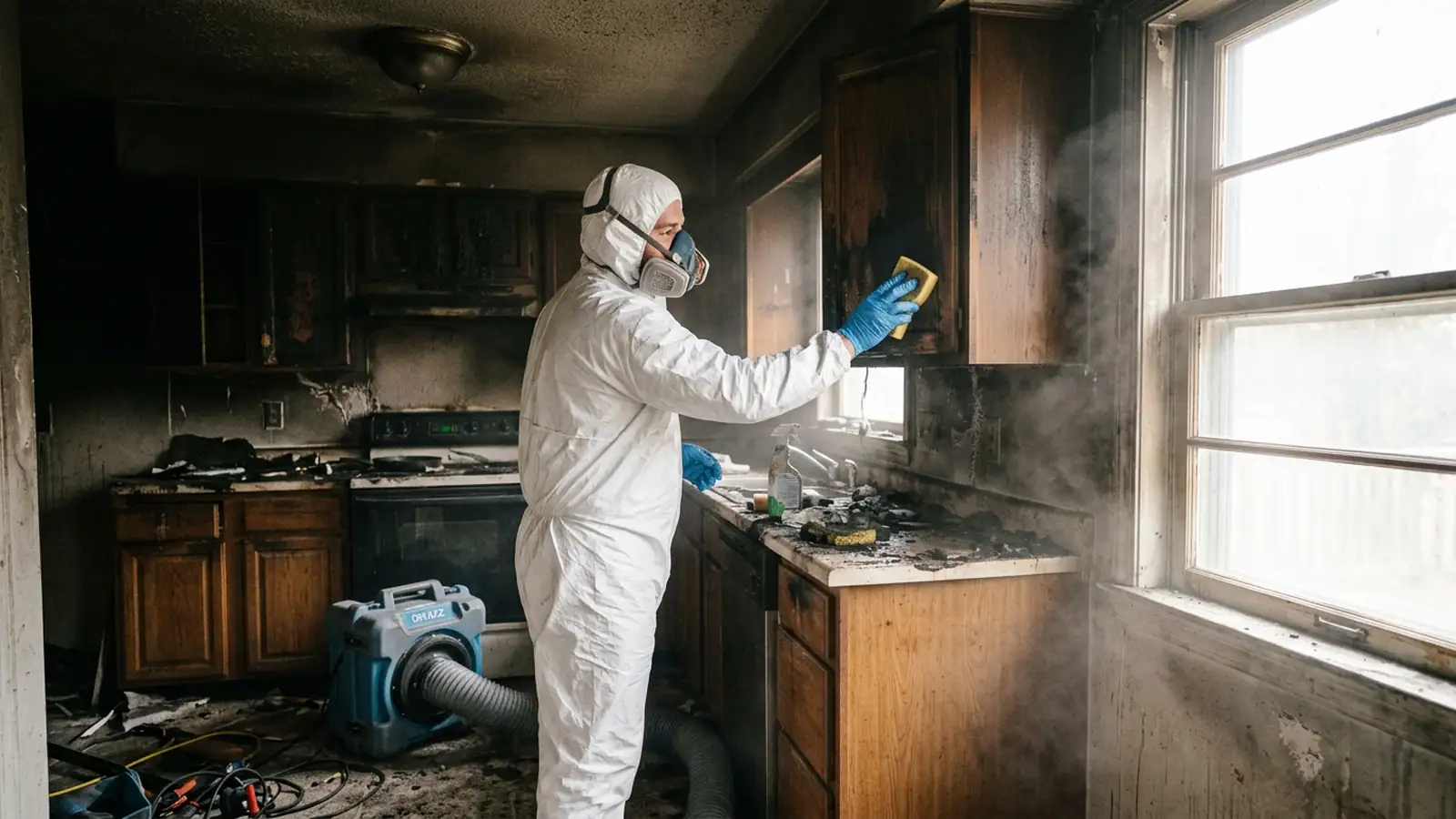
Whether a kitchen fire filled your Greenbelt home with smoke or a structural fire displaced your family, the path back starts with stabilization: board-up, water removal and soot cleaning. Water Restoration puts you in touch with local crews who handle every phase, from the first tarp to the final coat of paint, and who document everything for your insurance claim.
Properties in Greenbelt (Prince George's County) range over older homes along the original streets, newer subdivisions, rural properties on the outskirts and small businesses downtown. Home fires peak in winter, when space heaters, fireplaces and furnaces are running and holiday cooking and decorating add risk. Oil-heated homes in the region also see furnace puff-backs, which coat every room with oily soot.
What Greenbelt fire restoration crews respond to
Greenbelt shares the weather and building patterns of the rest of the state. Maryland stretches from Chesapeake Bay tidal communities to the mountains, so flood risk ranges from storm surge to flash floods in steep stream valleys. Humid summers, older housing in Baltimore and the inner suburbs, and basement-heavy construction make mold and sewer backups common complaints. Problems tend to peak during summer thunderstorms and the fall tropical season, but plumbing failures and appliance leaks happen in every month of the year.
- Garage, workshop and vehicle fires
- Oil furnace puff-backs that coat every room in soot
- Electrical fires when power is restored to water-damaged wiring after a storm
- Electrical shorts in humid attics and crawlspaces
- Small fires that were extinguished quickly but filled the house with smoke
- Clothes dryer lint fires
- Electrical fires from aging wiring, overloaded circuits and outdated panels
- Furnace malfunctions at the start of heating season
Why fire damage gets worse by the day
Three forms of damage continue after the flames are out. Soot residue corrodes and stains surfaces progressively. Odor molecules migrate deeper into porous materials. And suppression water, often hundreds of gallons, swells, delaminates and eventually grows mold in everything it touched. Early stabilization changes what can be saved.
That is why restoration companies in Greenbelt aim to be on site within a day or two of the fire even when reconstruction will take months. Board-up protects the property; extraction and drying stop the water damage; and the first cleaning pass removes the most corrosive residue.
How fire restoration works
- Dispatch and assessment. A local crew confirms the property is safe to enter and plans the stabilization.
- Securing the structure. Broken openings are boarded, damaged roofing tarped and the site secured.
- Water removal and drying. Suppression water is extracted and the structure dried to prevent secondary damage and mold.
- Soot and smoke removal. Surfaces are cleaned with dry sponges, HEPA vacuuming and the chemistry matched to the type of residue; ductwork is cleaned.
- Contents processing. Furniture, clothing, electronics and documents are inventoried, cleaned where possible and stored until the home is ready.
- Odor removal with thermal fogging, hydroxyl or ozone and sealing of structural surfaces, followed by full reconstruction.
Salvage versus replace
More than most people expect. Glass, ceramics, metal and sealed wood clean well. Many textiles are restorable with specialty laundering and ozone. Electronics that were not exposed to heat can often be cleaned and tested, and documents and photos can be freeze-dried. Items generally not salvageable include food and medicine exposed to heat or smoke, melted plastics, mattresses, particleboard furniture and heavily sooted drywall and insulation.
Cost and insurance considerations
The cost of fire damage restoration depends on the size of the fire, the type of smoke residue, how far it traveled through the building and how much of the structure and contents can be cleaned rather than replaced.
Fire is a named peril on standard policies. Expect the claim to involve a structural estimate, a contents inventory and, if you cannot stay in the home, additional living expense coverage.
Ask the crew to walk you through the estimate and the claim process; good documentation from day one is the best way to get a claim paid.
Service area: Greenbelt and Prince George's County
We route calls from ZIP codes 20768, 20770 and 20771 to restoration companies that work Greenbelt and Prince George's County every week.
The same crews also serve nearby communities including Beltsville (3 mi), Hyattsville (4 mi), Glenn Dale (4 mi), College Park (5 mi), Bladensburg (5 mi), Brentwood (6 mi), Mount Rainier (6 mi), Laurel (7 mi), Burtonsville (7 mi) and Takoma Park (7 mi). If you are just outside Greenbelt, call anyway; coverage areas overlap.
Why call Water Restoration
- You are connected with a restoration company that actually serves Greenbelt, not a national call center that will call you back tomorrow
- Restoration companies in the network are independent local businesses; confirm their licensing and insurance and get the scope in writing
- One number covers water, fire, smoke, mold, sewage and biohazard emergencies
- Crews document the loss with photos, moisture readings and itemized estimates in the format insurance adjusters expect
- Calls are answered 24 hours a day, including nights, weekends and holidays
Fire Damage in Greenbelt: FAQs
What about the water the fire department used?
Suppression water is removed and the structure dried as part of the restoration. Left in place it causes swelling, delamination and mold within days, compounding the fire damage.
What should I do first after a fire at my Greenbelt home?
Make sure everyone is safe and do not re-enter until the fire department clears the structure. Call your insurance company to open a claim, then call (888) 755-3821 for emergency board-up and mitigation. Photograph the damage before anything is moved, if it is safe to do so.
Will insurance pay for a hotel while my house is repaired?
Most homeowners policies include additional living expense coverage for temporary housing and extra costs while the home is uninhabitable, up to the policy limit. Keep every receipt.
Is it safe to clean up soot myself?
Light soot on hard surfaces can be dry-sponged, but wet cleaning usually smears it deeper, and soot is a respiratory irritant that may carry toxic combustion byproducts. Significant soot or any odor problem is best handled professionally.
Can smoke smell be removed completely?
Yes, when the sources are addressed: removing heavily contaminated materials, cleaning everything else including ducts, sealing structural surfaces and treating air and cavities with thermal fogging or hydroxyl. Painting over smoke without cleaning and sealing rarely works.