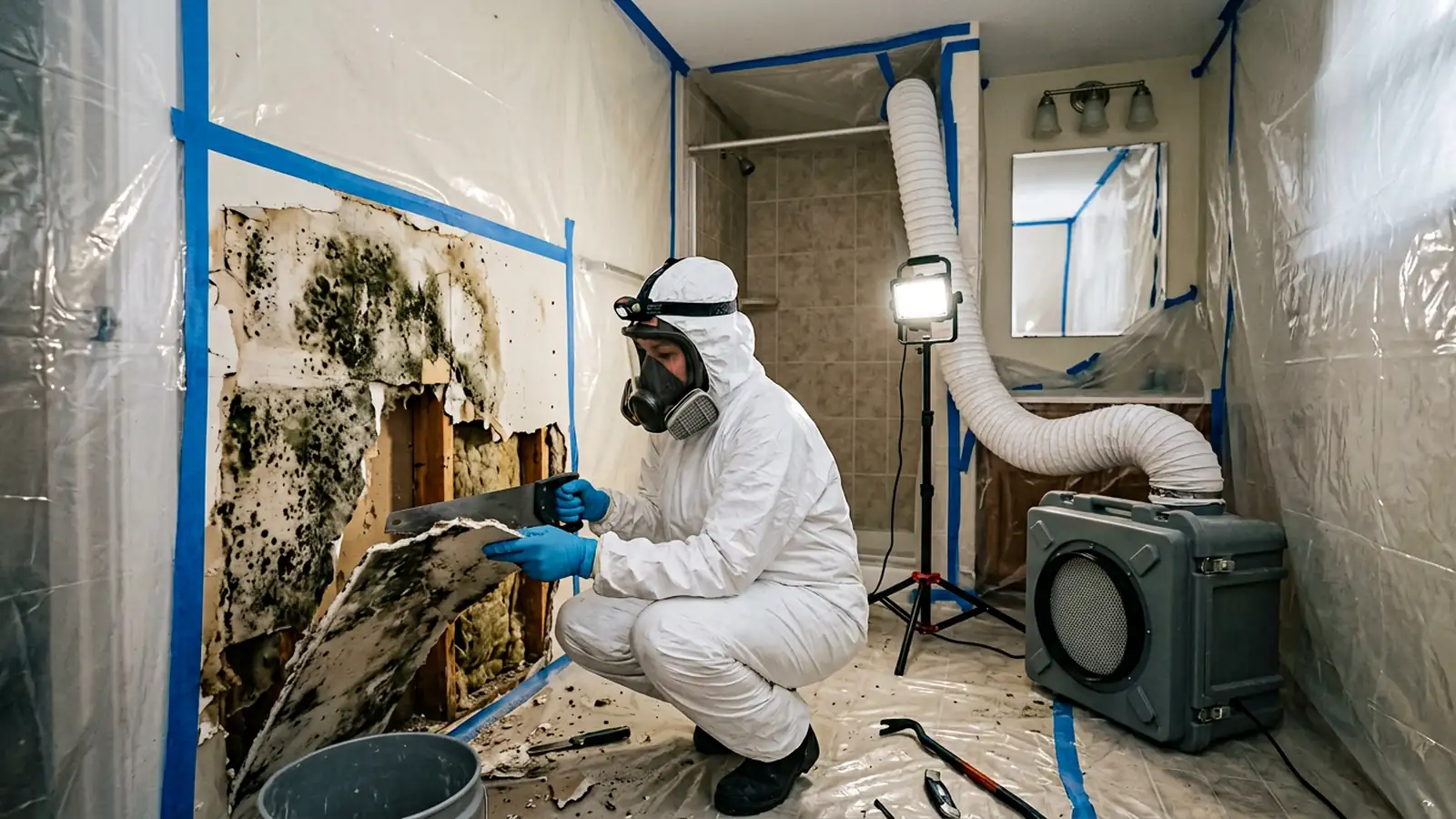
Humid summers mean mold can establish itself in days, and air-conditioned interiors create condensation on cold surfaces that keeps feeding it. In Annapolis, that makes it common for mold to show up weeks after a leak that seemed minor at the time. Call (888) 755-3821 and we will connect you with a remediation company that serves all 8 Annapolis ZIP codes, including 21401, 21402, 21403 for an inspection and a written scope.
Annapolis is a close-knit community in Maryland, home to roughly 40,700 residents, with a mix of historic homes, post-war neighborhoods and newer construction, with farms and acreage properties nearby. Every property type in Annapolis has its own failure points, which is why crews map moisture with meters and infrared cameras before deciding what to remove.
Where mold comes from in Annapolis homes
Maryland stretches from Chesapeake Bay tidal communities to the mountains, so flood risk ranges from storm surge to flash floods in steep stream valleys. Humid summers, older housing in Baltimore and the inner suburbs, and basement-heavy construction make mold and sewer backups common complaints. Remediation that wipes or sprays the visible growth without fixing the source fails every time, which is why every job starts with a moisture investigation.
- Basement walls and floors that stay damp after rain and snowmelt
- Bathroom fans venting into cold attics
- Roof leaks that stain ceilings and wet attic insulation
- Bathrooms with poor ventilation and recurring ceiling or grout mold
- HVAC systems and ductwork with mold on coils and insulation
- Slow plumbing leaks inside the walls of older homes
- Salt air and coastal humidity that keep building materials damp
- Window, door and siding leaks after heavy rain
DIY cleanup versus professional remediation
Small, surface-level growth on tile or sealed surfaces can be handled by a careful homeowner. Anything larger, anything hidden in cavities, anything following contaminated water, and anything involving sensitive occupants calls for containment, HEPA filtration and trained technicians. If you are not sure, an inspection will tell you which situation you are in.
Health agencies note that mold exposure can cause nasal congestion, throat and eye irritation, coughing and skin irritation, with more serious reactions in people with allergies, asthma or weakened immune systems. In Annapolis, where humidity is high for much of the year, symptoms that improve when you leave the house are a classic sign.
Containment, removal, verification
- Inspection. The contractor identifies the moisture source, maps affected materials and writes a scope.
- Containment. The work area is sealed with plastic sheeting and placed under negative air pressure so spores disturbed during removal do not spread.
- HEPA air filtration runs continuously during and after the work to capture airborne spores and dust.
- Removal and cleaning. Porous materials with growth are removed; framing and sheathing are cleaned by HEPA vacuuming, wiping and abrasive methods where required.
- Treatment with an EPA-registered antimicrobial where appropriate, and an encapsulant on cleaned framing when specified.
- Correction of the moisture source, drying to normal levels and verification, by inspection or independent clearance testing, before containment comes down and reconstruction begins.
Inspection, sampling and clearance
An inspection combines a visual examination, moisture meters and infrared imaging with, when warranted, air or surface samples analyzed by an accredited laboratory and compared with outdoor baselines. In Annapolis, inspections are most often requested after a home inspection flags growth, when a tenant reports symptoms, or when a past leak was never properly dried.
What mold damage remediation costs in Annapolis and what insurance covers
Mold remediation cost in Annapolis depends on the size of the affected area, how accessible it is, what materials are involved and whether the moisture source has already been fixed.
Insurance treats mold cautiously: it is often covered only when it results from a covered sudden loss, such as a burst pipe, and many policies cap mold coverage at a set dollar amount. Mold from humidity or long-term leaks is usually excluded.
Get the scope and pricing in writing, ask what the carrier typically covers, and keep every receipt for emergency expenses.
Annapolis neighborhoods and ZIP codes covered
Mold remediation crews dispatched through Water Restoration cover all 8 Annapolis ZIP codes, including 21401, 21402, 21403 in Anne Arundel County.
ZIP codes served in Annapolis: 21401, 21402, 21403, 21404, 21405, 21409, 21411, 21412.
The same crews also serve nearby communities including Pasadena (4 mi), Arnold (4 mi), Riva (4 mi), Edgewater (5 mi), Crownsville (6 mi), Severna Park (6 mi), Mayo (7 mi), Davidsonville (7 mi), Gibson Island (8 mi) and Crofton (9 mi). If you are just outside Annapolis, call anyway; coverage areas overlap.
Why Annapolis property owners call Water Restoration
- One number covers water, fire, smoke, mold, sewage and biohazard emergencies
- We route you to a local company that already works in Annapolis and Anne Arundel County
- There is no cost or obligation to call and talk through what you are seeing
- Calls are answered 24 hours a day, including nights, weekends and holidays
- Crews document the loss with photos, moisture readings and itemized estimates in the format insurance adjusters expect
Mold Remediation in Annapolis: FAQs
Is mold common in Annapolis?
Yes. Maryland's humidity means any leak or damp area can develop growth within days. Local crews see it year-round.
How long does mold remediation take in Annapolis?
A single room or small bathroom job often takes one to three days. Multi-room, attic or whole-basement projects can take a week or more, plus reconstruction afterward.
Do you remediate mold in commercial buildings in Annapolis?
Yes. Offices, retail spaces, multifamily buildings and other commercial properties are remediated under containment so the rest of the building can keep operating, with documentation for tenants, lenders and insurers.
Is black mold in my Annapolis home dangerous?
Color does not reliably indicate toxicity. Stachybotrys can produce mycotoxins, but many harmless molds are dark and some light-colored molds are strongly allergenic. Any significant indoor growth should be removed and its moisture source fixed, regardless of color.
What does mold smell like, and what if I smell it but cannot see it?
A musty, earthy odor, often strongest in basements and after rain. Odor without visible growth usually means mold inside a wall, under flooring or in the HVAC system; a moisture inspection with infrared imaging can locate it.