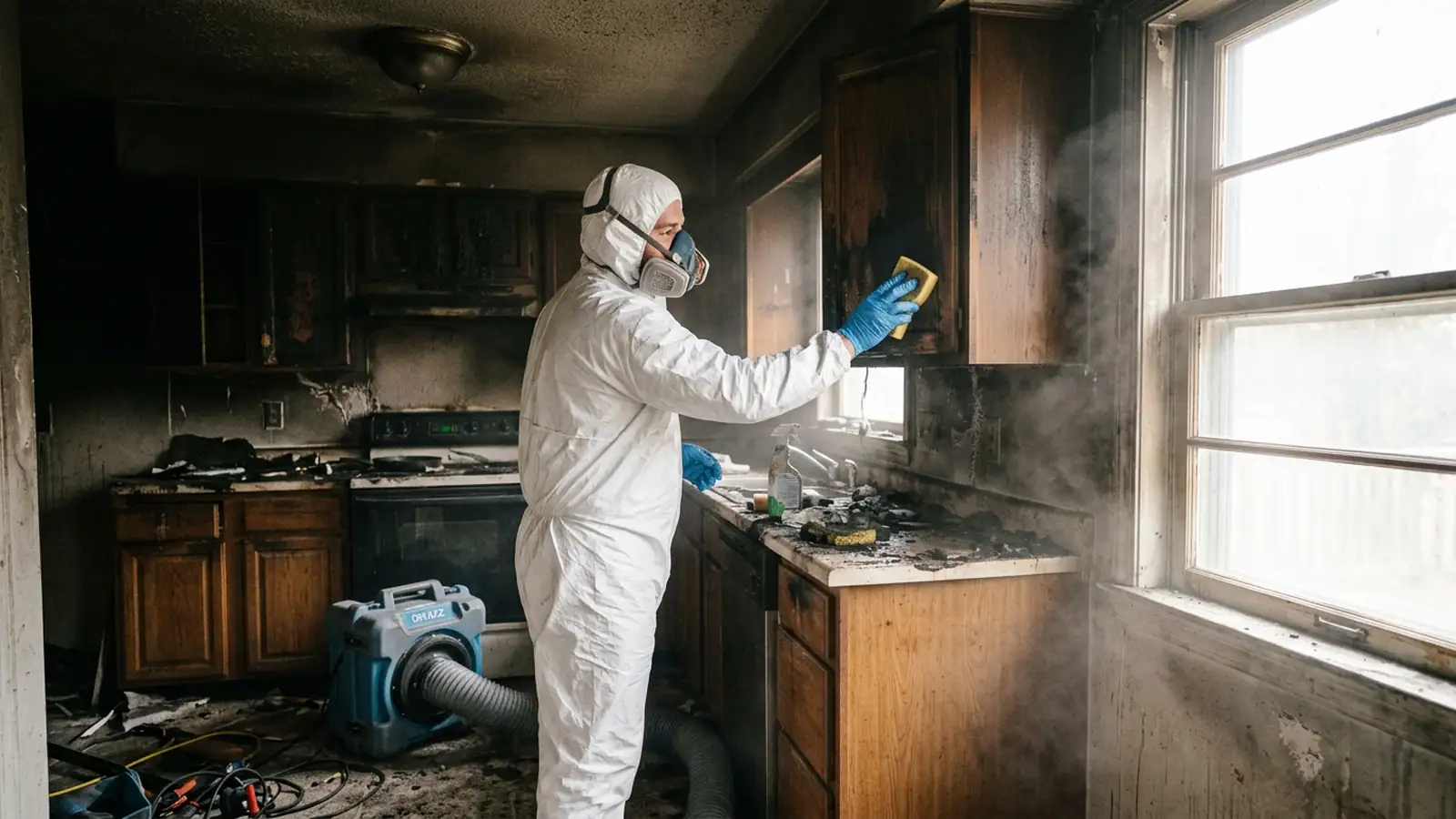
Fire damage in Waukegan gets worse every day it sits: soot etches glass and metal, odor sinks deeper into drywall and framing, and suppression water starts the clock on mold. Call (888) 755-3821 and we will connect you with a fire and smoke restoration company that serves ZIP codes 60079, 60085 and 60087 for emergency board-up and the start of cleanup.
Properties in Waukegan (Lake County) range over older homes near the center of town, newer developments on the edges and a healthy base of local businesses. Home fires peak in winter, when space heaters, fireplaces and furnaces are running and holiday cooking and decorating add risk.
Fire and smoke damage we handle in Waukegan
The risks in Waukegan in Lake County are shaped by Illinois's climate and housing. Illinois homes are mostly built over basements, and sump pump failures, sewer backups during heavy rain, and burst pipes during polar cold snaps are the state's most common water losses. Older Chicago-area housing stock and river flooding along the Mississippi and Illinois rivers add to the exposure. Problems tend to peak during spring rains and mid-winter cold, but plumbing failures and appliance leaks happen in every month of the year.
- Grill and outdoor cooking fires that spread to siding and decks
- Lightning strikes and downed power lines during severe storms
- Electrical fires from aging wiring, overloaded circuits and outdated panels
- Oil furnace puff-backs that coat every room in soot
- Furnace malfunctions at the start of heating season
- Kitchen and cooking fires, the leading cause of home fires
- Space heater, fireplace and chimney fires during cold weather
- Garage, workshop and vehicle fires
Why fire damage gets worse by the day
Soot is acidic. Within hours it discolors plastics and countertops; within days it etches glass, pits metal and permanently stains grout. Smoke odor penetrates drywall, insulation and upholstered contents and becomes harder to remove each day. Meanwhile the water used to put out the fire is soaking into the same materials, starting the mold clock that every water loss faces.
Emergency services on the first visit typically include board-up and tarping, water extraction, HEPA air filtration, protection of unaffected areas and an initial inventory of contents, with full cleaning and reconstruction following.
Our fire damage restoration process in Waukegan
- Emergency contact and safety check. Once the fire department releases the property, the crew evaluates structural stability, utilities and air quality.
- Securing the structure. Broken openings are boarded, damaged roofing tarped and the site secured.
- Water removal and drying. Suppression water is extracted and the structure dried to prevent secondary damage and mold.
- Structural cleaning. Walls, ceilings, cabinets, fixtures and the HVAC system are cleaned using methods chosen for wet, dry or protein smoke.
- Contents processing. Furniture, clothing, electronics and documents are inventoried, cleaned where possible and stored until the home is ready.
- Deodorization at the source, sealing of framing and subfloor, and reconstruction of damaged areas to code.
Contents: what is cleanable and what is not
More than most people expect. Glass, ceramics, metal and sealed wood clean well. Many textiles are restorable with specialty laundering and ozone. Electronics that were not exposed to heat can often be cleaned and tested, and documents and photos can be freeze-dried. Items generally not salvageable include food and medicine exposed to heat or smoke, melted plastics, mattresses, particleboard furniture and heavily sooted drywall and insulation.
Cost and insurance considerations
Fire restoration costs in Waukegan vary enormously, from a few days of cleaning after a contained kitchen fire to months of reconstruction after a structural fire.
Fire and smoke are covered perils in essentially every homeowners and commercial property policy, and most policies include additional living expenses if the property cannot be occupied during repairs.
The restoration companies we connect you with in Waukegan handle claims every day and can explain what is likely to be covered before work begins.
Areas we serve in and around Waukegan
We route calls from ZIP codes 60079, 60085 and 60087 to restoration companies that work Waukegan and Lake County every week.
The same crews also serve nearby communities including North Chicago (2 mi), Gurnee (5 mi), Great Lakes (5 mi), Zion (5 mi), Wadsworth (6 mi), Lake Bluff (6 mi), Lake Villa (7 mi), Winthrop Harbor (7 mi), Libertyville (8 mi) and Russell (9 mi). If you are just outside Waukegan, call anyway; coverage areas overlap.
What to expect when you call about fire damage restoration in Waukegan
- We route you to a local company that already works in Waukegan and Lake County
- There is no cost or obligation to call and talk through what you are seeing
- Calls are answered 24 hours a day, including nights, weekends and holidays
- The companies we work with deal with insurance adjusters daily and can bill covered mitigation directly to your carrier
- Restoration companies in the network are independent local businesses; confirm their licensing and insurance and get the scope in writing
Fire Damage in Waukegan: FAQs
Can I choose my own restoration contractor?
In nearly all cases, yes. Be cautious of anyone who shows up uninvited at a fire scene. Take the time to call a company you have vetted and get the scope in writing.
Will insurance pay for a hotel while my house is repaired?
Most homeowners policies include additional living expense coverage for temporary housing and extra costs while the home is uninhabitable, up to the policy limit. Keep every receipt.
Does my HVAC system need cleaning after a fire?
Almost always. Ducts, the air handler and filters collect soot and redistribute it every time the system runs. Cleaning the system and replacing filters is standard in smoke restoration.
What about the water the fire department used?
Suppression water is removed and the structure dried as part of the restoration. Left in place it causes swelling, delamination and mold within days, compounding the fire damage.
My neighbor had a fire and my place smells like smoke. Can you help?
Yes. Smoke that migrated through shared walls, windows or vents still leaves acidic residue and odor. Cleaning and deodorizing are covered by most policies as smoke damage, and local crews handle these losses regularly in Waukegan.