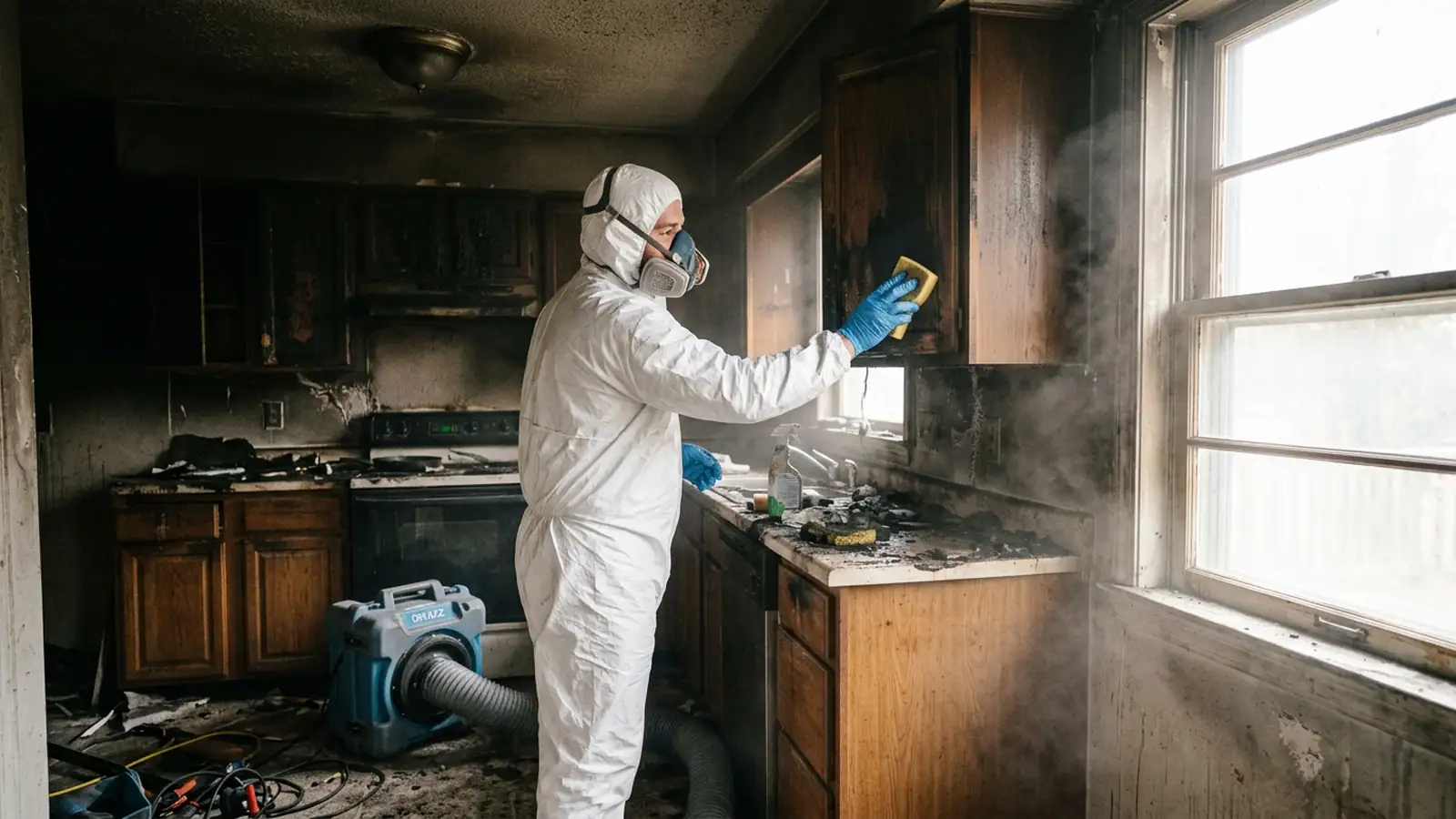
After the fire trucks leave a Dallas home, what remains is a structure that is wet from suppression water, coated in acidic soot and saturated with smoke odor, often with openings to the weather. Water Restoration connects you with local fire damage restoration crews that secure the property, remove the water, clean the soot, eliminate the odor and rebuild.
Properties in Dallas (Paulding County) range over a mix of historic homes, post-war neighborhoods and newer construction, with farms and acreage properties nearby. Late summer and fall bring wildfire smoke and structure fire risk, while kitchen fires remain the leading cause year-round.
Fire and smoke damage we handle in Dallas
Property owners in Dallas deal with the same regional risks found throughout Georgia. Georgia's humid subtropical climate, heavy rain events and occasional tropical systems moving inland keep crawlspaces and basements damp, and the state's spring severe-weather season produces wind and hail damage. Clay soils that swell and shrink also stress foundations and buried plumbing. Problems tend to peak during spring storm season and late summer, but plumbing failures and appliance leaks happen in every month of the year.
- Garage, workshop and vehicle fires
- Electrical fires when power is restored to water-damaged wiring after a storm
- Electrical shorts in humid attics and crawlspaces
- Wildfire smoke, ash and soot infiltration, and structure fires at the wildland edge
- Grill and outdoor cooking fires that spread to siding and decks
- Kitchen and cooking fires, the leading cause of home fires
- Lightning-caused attic and roof fires
- Lightning strikes and downed power lines during severe storms
Soot, odor and water: three clocks running at once
Three forms of damage continue after the flames are out. Soot residue corrodes and stains surfaces progressively. Odor molecules migrate deeper into porous materials. And suppression water, often hundreds of gallons, swells, delaminates and eventually grows mold in everything it touched. Early stabilization changes what can be saved.
Emergency services on the first visit typically include board-up and tarping, water extraction, HEPA air filtration, protection of unaffected areas and an initial inventory of contents, with full cleaning and reconstruction following.
From board-up to rebuild
- Dispatch and assessment. A local crew confirms the property is safe to enter and plans the stabilization.
- Board-up, tarping and security. Windows, doors and roof openings are sealed against weather, animals and intruders.
- Water removal and drying. Suppression water is extracted and the structure dried to prevent secondary damage and mold.
- Soot and smoke removal. Surfaces are cleaned with dry sponges, HEPA vacuuming and the chemistry matched to the type of residue; ductwork is cleaned.
- Contents inventory, pack-out and cleaning. Salvageable belongings are documented, cleaned on or off site and stored; non-salvageable items are listed for the claim.
- Deodorization at the source, sealing of framing and subfloor, and reconstruction of damaged areas to code.
Contents: what is cleanable and what is not
More than most people expect. Glass, ceramics, metal and sealed wood clean well. Many textiles are restorable with specialty laundering and ozone. Electronics that were not exposed to heat can often be cleaned and tested, and documents and photos can be freeze-dried. Items generally not salvageable include food and medicine exposed to heat or smoke, melted plastics, mattresses, particleboard furniture and heavily sooted drywall and insulation.
What fire damage restoration costs in Dallas and what insurance covers
The cost of fire damage restoration depends on the size of the fire, the type of smoke residue, how far it traveled through the building and how much of the structure and contents can be cleaned rather than replaced.
Fire is a named peril on standard policies. Expect the claim to involve a structural estimate, a contents inventory and, if you cannot stay in the home, additional living expense coverage.
Ask the crew to walk you through the estimate and the claim process; good documentation from day one is the best way to get a claim paid.
Service area: Dallas and Paulding County
Coverage in Dallas includes ZIP codes 30132 and 30157, along with the rest of Paulding County.
The same crews also serve nearby communities including Hiram (5 mi), Powder Springs (9 mi), Rockmart (14 mi), Temple (14 mi), Douglasville (14 mi), Villa Rica (14 mi), Kennesaw (15 mi), Mableton (15 mi), Austell (15 mi) and Lithia Springs (15 mi). If you are just outside Dallas, call anyway; coverage areas overlap.
Why Dallas property owners call Water Restoration
- Calls are answered 24 hours a day, including nights, weekends and holidays
- One number covers water, fire, smoke, mold, sewage and biohazard emergencies
- The companies we work with deal with insurance adjusters daily and can bill covered mitigation directly to your carrier
- There is no cost or obligation to call and talk through what you are seeing
- You can ask about licensing, insurance and IICRC certification before any work begins, and you should
Fire Damage in Dallas: FAQs
Does my HVAC system need cleaning after a fire?
Almost always. Ducts, the air handler and filters collect soot and redistribute it every time the system runs. Cleaning the system and replacing filters is standard in smoke restoration.
Can smoke smell be removed completely?
Yes, when the sources are addressed: removing heavily contaminated materials, cleaning everything else including ducts, sealing structural surfaces and treating air and cavities with thermal fogging or hydroxyl. Painting over smoke without cleaning and sealing rarely works.
Can I choose my own restoration contractor?
In nearly all cases, yes. Be cautious of anyone who shows up uninvited at a fire scene. Take the time to call a company you have vetted and get the scope in writing.
What about the water the fire department used?
Suppression water is removed and the structure dried as part of the restoration. Left in place it causes swelling, delamination and mold within days, compounding the fire damage.
My neighbor had a fire and my place smells like smoke. Can you help?
Yes. Smoke that migrated through shared walls, windows or vents still leaves acidic residue and odor. Cleaning and deodorizing are covered by most policies as smoke damage, and local crews handle these losses regularly in Dallas.